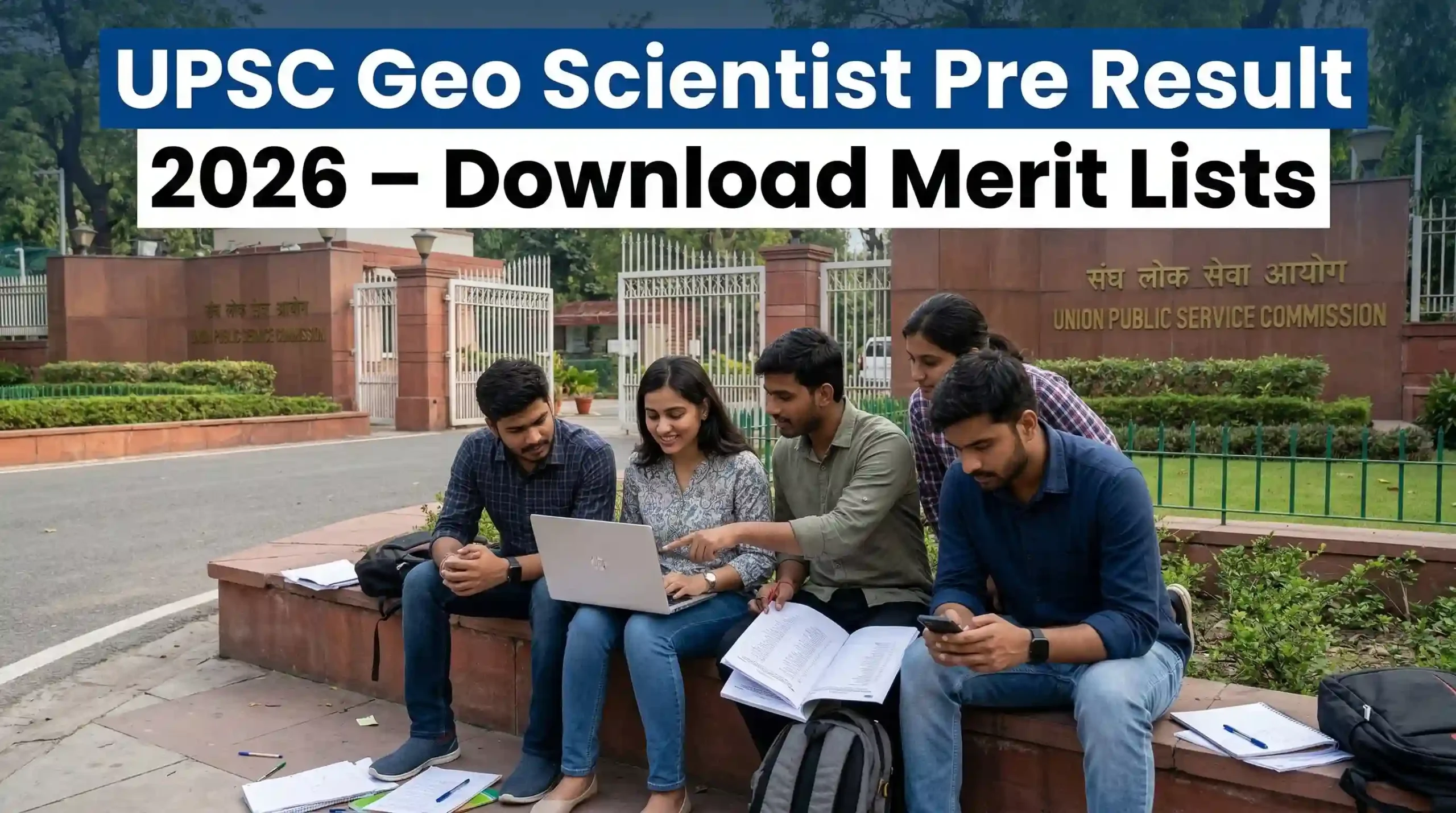
UPSC Geo Scientist Pre Result 2026 Out: Download Merit Lists
🚨 Critical Result Alert & Fast Facts:
- Authority: Union Public Service Commission (UPSC).
- Advertisement: Advt No. 01/2026 GEOL.
- Vacancies: 85 Elite Group A & B technical posts.
- Status: Preliminary Results officially declared on 02 March 2026.
- Action Required: Qualified candidates must prepare for the DAF (Detailed Application Form) and subjective Mains exam.
🔥 Next Steps & Updates:
Successful candidates must immediately pivot to Mains preparation. Stay connected with sarkarinaukri.com.cm for real-time updates on DAF activation and Phase II schedules.
1. Important Dates & Mains Timeline
Scroll Right ↔
| Examination Event | Official Date | Important Remarks & Action |
|---|---|---|
| Preliminary Exam Date | 08 February 2026 | Objective test successfully concluded nationwide. |
| Prelims Result Declaration | 02 March 2026 | Merit list PDF is now available for download. |
| DAF (Mains) Registration | To Be Notified | Crucial Step: Do not miss the short 10-14 day window. |
| Mains Exam Date | To Be Notified | Track schedules closely on sarkarinaukri.com.cm. |
2. Post-Wise Vacancy Distribution Matrix
Scroll Right ↔
| Service / Designation | Post Grouping | Organization Details |
|---|---|---|
| Geologist / Geophysicist / Chemist | Group A (Category I) | Geological Survey of India. |
| Scientist B (Hydrogeology/Chemical/Geophysics) | Group A (Category II) | Central Ground Water Board. |
| Assistant Roles (Hydrogeologist/Chemist/Geophysicist) | Group B | Subject to specific central reservations. |
| Total Grand Vacancies | 85 Elite Posts | Includes horizontal quotas for PwBD applicants. |
3. Step-by-Step Guide to Check Prelims Result
- Access Portal: Visit the official
upsc.gov.inwebsite or use the direct PDF links provided on sarkarinaukri.com.cm. - Locate Result: Check the “Written Results” or “What’s New” scrolling marquee section on the homepage.
- Download PDF: Click on “Combined Geo-Scientist (Preliminary) Examination, 2026 Result.”
- Search Data: Use “Ctrl + F” and type in your 7-digit exam Roll Number or full legal name.
- Confirmation: If highlighted, you are shortlisted! Save the file and prepare for the Mains DAF process.
4. The DAF (Detailed Application Form) Procedure
Mandatory Requirement: Qualifying the prelims is just stage one. Candidates MUST submit the DAF via upsconline.nic.in to sit for the Mains.
- Requires an exhaustive declaration of academic, demographic, and employment history.
- Must upload original scanned degree certificates, age proofs, and valid category certificates (EWS/OBC/SC/ST).
- Missing the strict DAF deadline results in automatic cancellation of your candidature.
5. Prelims Exam Pattern & Negative Marking Review
Scroll Right ↔
| Prelims Paper | Subject / Max Marks | Rules & Penalties |
|---|---|---|
| Paper I | General Studies (100 Marks) | Format: Objective MCQs.
Penalty: Strict 1/3rd (0.33) marks deducted per incorrect bubble. Blind guessing was heavily penalized, keeping cut-offs competitive. |
| Paper II | Domain Specific (300 Marks) |
6. Expected Cut-Off Marks Analysis
Scroll Right ↔
| Category | Predictive Range (Out of 400) | Important Remarks |
|---|---|---|
| Unreserved (UR) | 210 – 235 Marks | Highest baseline threshold. Depends heavily on Paper II accuracy. |
| OBC | 190 – 215 Marks | Official marks released only after final recruitment cycle ends. |
| SC / ST | 160 – 185 Marks | Check sarkarinaukri.com.cm for definitive mark sheets upon release. |
7. Mains Exam Pattern & Subject-Wise Weightage
Scroll Right ↔
| Mains Exam Structure | Max Marks & Duration | Critical Format Details |
|---|---|---|
| Paper I (Domain Specific) | 200 Marks | 3 Hours | Format: 100% Subjective/Descriptive. Rules: No negative marking, but requires flawless derivations and structured scientific articulation across a gruelling 2-day schedule. Very different from the Railway RRB Level 1 objective format. |
| Paper II (Domain Specific) | 200 Marks | 3 Hours | |
| Paper III (Domain Specific) | 200 Marks | 3 Hours |
8. Educational Eligibility & Final Year Rules
Scroll Right ↔
| Eligibility Type | Mandatory Standard | Exceptions & DAF Rules |
|---|---|---|
| Basic Qualification | Master’s Degree in Geology, Physics, Chemistry, Hydrogeology or equivalents. | Degrees must be from recognized Indian universities. |
| Final Year / Appearing Students | Fully Eligible to write Prelims and Mains. | Strict Caveat: Must produce the original passing certificate during the Final Interview phase, else permanently disqualified. |
9. Age Limits & Category-Wise Relaxation Matrix
Crucial Cutoff Date: All ages are verified exactly as of 01 January 2025.
Scroll Right ↔
| Candidate Category | Statutory Relaxation | Max Age Limit (As of 01/01/2025) |
|---|---|---|
| Unreserved (UR) | No Relaxation | 32 Years (Base Min: 21) |
| OBC (Non-Creamy Layer) | + 3 Years | 35 Years |
| SC & ST Candidates | + 5 Years | 37 Years |
| PwBD Candidates | + 10 Years | 42 Years |
10. Medical Standards & Physical Fitness Criteria
Scroll Right ↔
| Test Component | Standard Requirements (Annexure III) | Critical Remarks |
|---|---|---|
| CSMB Certification | Mandatory clearance from Central Standing Medical Board. | Ensures stamina for demanding fieldwork. |
| Visual Acuity | Strict myopic limits. Must pass specific Color Vision tests. | Not as physically punishing as MPESB Van Rakshak rules, but strict on organ health. |
11. Salary Structure & Career Progression
Scroll Right ↔
| Component | Financial Details | Career Growth & Perks |
|---|---|---|
| Pay Matrix | 7th Pay Commission Level 10. | Hierarchy: Geologist ➔ Senior Geologist ➔ Superintending Geologist ➔ Deputy Director General.
Highly prestigious Group A Central Service. |
| Basic & Allowances | Basic starts at ₹ 56,100. Includes central DA, tier-based HRA, and TA. | |
| Gross In-Hand | Lucrative starting salary with exhaustive lifetime medical perks. |
12. Mains Preparation Strategy & Quick Tips
- Discard Objective Tricks: The Mains format is strictly descriptive. Shift focus entirely to writing long-form, analytical answers based on PG university textbooks.
- Diagrammatic Precision: Practice drawing meticulously labeled geological structures or complex chemical mechanisms daily.
- Mock Testing: Simulate 3-hour timed conditions strictly. Muscle memory and writing speed are critical to finishing the 200-mark subjective papers.
- Peer Review: Evaluate answers focusing on structural coherence and scientific articulation to secure maximum evaluation points.
13. IMPORTANT DOWNLOAD LINKS DASHBOARD
| Download Pre Result PDF (Roll No Wise) | Click Here to Download |
| UPSC DAF Portal for Mains Registration | Access DAF Portal |
| Check Official Pre Admit Card Notice | View Notice |
| Download Official Advt 01/2026 Notification | Download PDF |
| Check UPSC Official Marks Portal | Check Marks Here |
| UPSC Official Master Website | Visit Official Portal |
| Explore More Latest Central Jobs | View Latest Jobs |
14. Frequently Asked Questions (FAQs)
| Q: What is the syllabus and exam pattern for the UPSC IES/ISS Exam 2026? A: The IES comprises 6 purely descriptive papers (1000 marks) focusing entirely on Economics, English, and GS. The ISS features 6 papers (1000 marks), uniquely blending 2 Objective Statistics (MCQ) papers and 2 Descriptive Statistics papers, alongside English/GS. |
| Q: What is the salary of a UPSC IES or ISS officer? A: Both IES and ISS are elite Group A services. Officers start at Pay Level 10 under the 7th Pay Commission, with a basic pay of ₹ 56,100. Combined with central DA and HRA, the initial gross monthly salary is highly lucrative. |
| Q: Is there any negative marking in the UPSC ISS objective papers? A: Yes, strictly for the ISS examination. The Statistics-I and Statistics-II objective (MCQ) papers enforce a standard UPSC 1/3rd negative marking penalty for every incorrect answer. The IES exam, being entirely descriptive, has no negative marking. |
| Q: Can final year Post-Graduation students apply for the UPSC IES exam? A: Yes, “appearing” students in their final PG year can apply and write the Prelims. However, they must possess and submit their original, finalized passing degree certificate when filling out the Detailed Application Form (DAF) post-written results. |
| Q: What is the exact age limit and attempt limit for UPSC IES/ISS 2026? A: The age limit is 21 to 30 years as of 01 August 2026 (relaxable for OBC/SC/ST/PwBD). Unreserved (General) and EWS candidates are strictly limited to a maximum of 6 attempts at the examination. |
| Q: What are the medical fitness standards for UPSC ISS and IES officers? A: Recommended candidates must clear a rigorous Medical Board examination at a designated central hospital. It ensures candidates are free from chronic diseases and meet specific visual acuity and psychological standards required for high-level government service. |
| Q: How do I apply online through the UPSC OTR portal? A: Visit upsconline.nic.in via sarkarinaukri.com.cm. First, complete the One Time Registration (OTR) to generate a permanent profile. Then, proceed to Part I to fill educational details, and Part II to pay the ₹200 fee and upload photos/signatures. |
| Q: What is the difference between the eligibility for IES and ISS? A: IES strictly requires a Post-Graduate (Master’s) degree in Economics or related fields. ISS is more flexible; candidates can apply with a Bachelor’s degree featuring Statistics as a subject, OR a full Master’s degree in Statistics. |
Disclaimer: This guide provides immediate informational reference regarding the UPSC Combined Geo-Scientist 2026 result and recruitment cycle. Please verify all result PDFs, DAF dates, medical fitness metrics, and formal procedures exclusively on the official Union Public Service Commission website (upsc.gov.in). sarkarinaukri.com.cm is not responsible for any inadvertent data errors or official mid-cycle changes.