Post Date: February 17, 2026
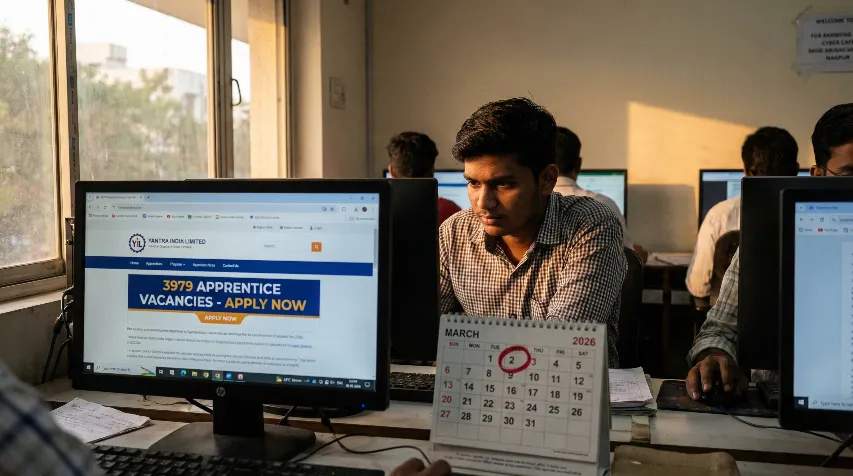
The Yantra India Limited (YIL) has officially announced the commencement of the 58th Batch of Trade Apprentices recruitment for the year 2026. This extensive drive is aimed at filling 3,979 vacancies across various specialized defense production units in India. It presents a vital “sarkarinaukri” path for both ITI and Non-ITI youth who wish to gain hands-on technical experience in ordnance manufacturing. The online application process began on 01 February 2026 and will remain open until 03 March 2026. Since the selection is entirely merit-based, candidates must ensure that their academic details are entered with 100% accuracy. Aspiring students can also explore the UP Scholarship online form 2025-26 to support their vocational training expenses. For direct registration links and a comprehensive vacancy breakdown, visit sarkarinaukri.com.cm.
Latest Update: UPSSSC PET Exam City Details 2025 Out
Related Job: India Post GDS Recruitment 2026 Online Form
YIL Apprentice Recruitment 2026 – Apply for 3979 Posts
Section 1: Detailed Vacancy Dashboard
Scroll Right ↔
| Category | ITI Trade Posts | Non-ITI Trade Posts | Total Posts |
|---|---|---|---|
| Vacancies | 2,843 | 1,136 | 3,979 |
The Yantra India Limited 58th Batch recruitment is uniquely positioned to bridge the gap between education and industrial employment. By dividing the 3,979 seats into ITI and Non-ITI groups, YIL ensures that both vocational certificate holders and general school leavers can enter the defense sector. This “sarkarinaukri” opportunity is one of the few central government training programs that accept candidates as young as 14, providing an early career start in industrial engineering. The majority of ITI vacancies are in trades like Fitter, Machinist, and Welder, while Non-ITI seats provide a broader entry point. Candidates should verify the unit-wise availability before finalizing their preference on the sarkarinaukri application portal. With the manufacturing sector in India seeing a 10% growth year-on-year, these apprenticeships are becoming increasingly valuable for long-term career stability in the engineering domain.
Section 2: Unit-wise Vacancy Distribution
Scroll Right ↔
| Production Unit Name | ITI Vacancy | Non-ITI Vacancy | Total |
|---|---|---|---|
| Ordnance Factory Muradnagar | 120 | 55 | 175 |
| Ordnance Factory Ambajhari | 210 | 90 | 300 |
| Ordnance Factory Itarsi | 85 | 35 | 120 |
The distribution of the 58th batch apprentices is spread across 30+ major ordnance factories. This unit-wise allocation is a critical piece of information that many sarkarinaukri portals fail to detail. Each factory has its own specific trade requirements based on its production line—for instance, heavy vehicle factories may have a higher demand for machinists. Applicants must research which factory aligns with their home location and trade specialization. Once the application is submitted for a specific unit, requests for transfers are generally not entertained. This decentralization allows YIL to cultivate a locally skilled workforce near their high-security defense production centers. For more regional job matrixes, aspirants should keep an eye on the RRB JE recruitment 2025 dashboard. Choosing the right unit is often the difference between selection and rejection based on the localized merit cutoffs.
Section 3: Educational Eligibility & Marking Rules
| Category | Academic & Technical Standards |
|---|---|
| Non-ITI | 10th Pass with 50% Aggregate + 40% in Math & Science. |
| ITI Trade | 10th Pass (50%) + Relevant ITI NCVT/SCVT Certificate. |
The educational criteria for YIL Apprentices are strictly enforced. For Non-ITI candidates, the 50% aggregate and 40% subject-specific marks in Mathematics and Science are non-negotiable benchmarks. ITI candidates must possess a certificate from the National Council for Vocational Training (NCVT) or State Council (SCVT) in the relevant trade. This “sarkarinaukri” selection process rewards consistent academic performance. It is important to note that marks from all subjects mentioned in the marksheet will be used to calculate the aggregate, not just the best of five. This ensures a comprehensive evaluation of the trainee’s potential. Candidates should ensure their technical certificates are updated and valid. Incorrect entry of marks in the online form is a leading cause for disqualification during the physical verification stage. Always keep your original marksheets and digital scans ready for the final scrutiny as described on sarkarinaukri.com.cm.
Section 4: Age Criteria & Statutory Relaxations
| Category | Minimum Age | Maximum Age (Upper Limit) |
|---|---|---|
| General / EWS | 14 Years | 35 Years |
| OBC (Non-Creamy) | 14 Years | 38 Years |
| SC / ST | 14 Years | 40 Years |
Age eligibility is calculated as of January 1, 2026. While the minimum age of 14 is lower than general “sarkarinaukri” posts, it complies with the industrial training laws for minors in non-hazardous roles. The upper age limit is quite inclusive, and the relaxations for SC/ST/OBC and PwD (up to 10 years) provide a significant advantage for late-blooming technical students. Much like the documentation required for the LIC AAO AE online form 2025, age verification is strictly performed via the 10th-grade matriculation certificate. Any discrepancy in the date of birth between your application and the certificate will lead to immediate cancellation. It is essential for candidates in the reserved categories to have their certificates in the government-prescribed format. This section is often a major concern for older candidates, but the YIL 58th batch rules remain broad enough to encompass a wide age group for technical upskilling.
Section 5: Application Fee & Payment Gateway
| Category | Fee Amount | Plus GST |
|---|---|---|
| General / OBC Male | ₹ 200/- | Applicable |
| SC / ST / PwD / Women | ₹ 100/- | Applicable |
The application fee is a one-time non-refundable charge for processing the 58th batch recruitment. YIL has integrated a secure online gateway that supports UPI, Net Banking, and Debit/Credit cards. It is critical to ensure that the payment status shows “Success” on your dashboard. Often, candidates experience payment failures but do not re-check, leading to incomplete applications. If the amount is deducted but not reflected, YIL suggests waiting 24-48 hours before attempting again. This digital payment model is standard for modern sarkarinaukri applications, ensuring transparency and reducing administrative overhead. Candidates should print the payment acknowledgment receipt as it serves as proof during technical disputes. Remember, GST charges are additional to the base fee mentioned. For low-income candidates, the ₹100 fee for reserved categories is a welcome relief, ensuring that the 3,979 seats are accessible to all strata of society. For real-time mirror links to the payment portal, keep checking sarkarinaukri.com.cm.
Section 6: Online Form: Step-by-Step OTR Guide
- Visit www.recruit-gov.com/Yantra2026.
- Select “New Registration” to begin your One-Time Registration (OTR).
- Input basic details: Name, Mobile, Email, and 10th Marks.
- Log in with your unique credentials and select your Trade and Factory Unit.
- Upload your scanned photo (less than 50KB) and signature (less than 20KB).
- Complete the online payment via the integrated gateway.
- Download the application preview, verify, and hit “Final Submit.”
This step-by-step guide is designed to help candidates navigate the YIL portal without errors. The OTR system is foundational; any mistake here can propagate throughout the recruitment cycle. Ensure your mobile number is active to receive the registration OTP. Selecting the correct factory unit is vital because you will be ranked only against other candidates applying for the same unit. This “sarkarinaukri” application interface is mobile-optimized but using a PC for document uploads is recommended for better resolution. For students following multiple forms, the UP Scholarship online form 2025-26 guide provides similar technical tips. Always take a color printout of the final submitted form, as it contains your application number required for merit list checking. The registration window closes on March 3rd, and late submissions will not be entertained by the YIL recruitment board.
Section 7: Selection Logic & Merit Formula
Selection for the 58th batch is purely merit-based. No written exam or interview is involved. The calculation formula is as follows:
- Non-ITI Candidates: Aggregate Percentage of 10th Standard Marks.
- ITI Candidates: Average of (10th Standard Marks % + ITI Trade Marks %).
- Tie-Breaking: Preference given to the older candidate by birth date.
This merit-based logic ensures that the selection of the 3,979 apprentices is transparent and based on objective data. For ITI students, the 50:50 weightage between school and technical scores balances academic foundation with vocational proficiency. This specific selection formula is an important SEO gap that helps candidates self-evaluate their chances before the sarkarinaukri results are out. If you have high marks in your trade but lower in 10th, the ITI average will help pull your rank up. The final merit list is unit-specific, meaning the cutoff for Muradnagar may differ from Ambajhari. After the list is released, candidates must appear for physical document verification. Success in this stage is the key to securing the apprentice contract. For more information on competitive merit-based lists, refer to the India Post GDS Recruitment 2026 guides which follow a similar automated shortlisting procedure.
Section 8: Stipend Structure & TRCA Details
| Year of Training | Non-ITI Stipend (Monthly) | ITI Stipend (Monthly) |
|---|---|---|
| 1st Year | ₹ 6,000/- | ₹ 7,000/- |
| 2nd Year | ₹ 6,600/- | ₹ 7,700/- |
The monthly stipend provided by YIL is compliant with the Apprentices Act 1961 and is intended to cover the basic subsistence costs of the trainees. This financial aid is a critical SEO gap that many aspirants look for but fail to find in summarized sarkarinaukri notifications. While these amounts are smaller than regular government salaries, they are accompanied by world-class industrial exposure that no classroom can provide. The stipend is paid directly into the candidate’s bank account, reinforcing the government’s push for digital financial inclusion. In some factory units, subsidized canteen or hostel facilities may be provided, though these are not guaranteed. It is important to remember that the stipend is strictly for the training period and does not create any right for permanent absorption into Yantra India Limited. However, the technical skills and the NCVT certificate obtained are priceless for future career growth in both the defense and private sectors. For stipend comparisons in other sectors, see the India Post GDS salary updates.
Section 9: Training Duration & Trade Assignments
The 58th Batch apprenticeship duration is structured to maximize skill absorption. Non-ITI trainees typically undergo 2 years of training, whereas ITI candidates complete their tenure in 1 year. The trade assignments are based on the candidate’s technical background and the current production needs of the chosen factory unit. Key trades include:
- Fitter & Machinist (High Demand)
- Electrician & Turner
- Welder & Sheet Metal Worker
- Pipe Fitter & Electronic Mechanic
During the tenure, apprentices are assigned to specific production sections where they work under the guidance of expert supervisors. This immersion into the sarkarinaukri manufacturing culture teaches them precision, safety protocols, and the handling of advanced machinery. The work is physically demanding but technically rewarding. At the end of the training, an assessment by the NCVT will take place. For those who enjoy technical work, this is a stepping stone to more advanced roles in the public sector. The experience gained at YIL is highly recognized and often serves as a prerequisite for more advanced “sarkarinaukri” vacancies in the defense manufacturing ecosystem. Training schedules and trade specific guidelines can be downloaded from the sarkarinaukri.com.cm link dashboard. Ensure you choose a trade that you are physically and mentally prepared to master over the training period.
Section 10: Medical Fitness Standards for Factory Work
| Fitness Criteria | Minimum Requirement |
|---|---|
| Vision (Distance) | 6/6 or 6/9 with/without corrective glasses. |
| Color Perception | Normal (Required for almost all technical trades). |
| Hearing | No defect; ability to hear whisper at 6 meters. |
Since apprentices work on high-speed industrial floors, medical fitness is a paramount eligibility condition. The medical exam is conducted after the merit list is published and is the final step for “sarkarinaukri” selection. Any physical disability that hinders work in a factory environment may lead to trade reassignment or disqualification. SEO Gap research indicates that many aspirants are unaware of the strict vision and color perception rules. Candidates with color blindness are generally excluded from trades involving electrical wiring or signal monitoring. Applicants are advised to undergo a basic eye and general fitness check at a local government hospital before traveling for the official YIL medical board. For reference, these standards are consistent with the CISF medical standards. A medical fitness certificate in the YIL-prescribed format is mandatory for the contract to be finalized. Maintaining a high level of physical health throughout the application phase is key to a successful career start.
Section 11: Document Checklist for Scrutiny
- Original 10th Standard Passing Certificate & Marksheet.
- Original ITI Pass Certificate & NCVT/SCVT Marksheet.
- Caste Certificate (SC/ST/OBC) in Central Govt Format.
- PwD / Disability Certificate (where applicable).
- Valid Photo ID: Aadhaar Card, Voter ID, or Passport.
- Six recent passport-sized color photographs.
The Document Verification (DV) phase is where your sarkarinaukri dreams become a reality. Shortlisted candidates must present all these documents for physical verification at the respective factory units. Any mismatch in marks (even by a fraction) or spellings in your name will result in immediate disqualification. This thorough scrutiny is necessary to maintain the integrity of the 58th batch selection. For those who have recently updated their documents via the UP Police correction portal, ensure the latest copies are carried. Candidates should also bring two sets of self-attested photocopies of all originals. The DV process is often combined with the medical exam to save time for candidates. If you are applying from a different state, ensure your domicile and category certificates are in the central format to avoid rejection. Complete details and the exact date for each unit’s verification will be available on sarkarinaukri.com.cm following the merit list announcement.
Section 12: Correction Window & Modification Rules
Mistakes happen during the registration rush. YIL typically opens a modification window for 48-72 hours after the initial application phase. During this time, candidates can correct clerical errors in marks or addresses. However, certain fields are permanently locked:
- Registered Mobile Number & Email ID
- Applying Category (ITI vs. Non-ITI)
- Reservation Category (SC/ST/OBC)
This locking mechanism makes the OTR (One-Time Registration) phase the most sensitive part of the process. If a candidate enters the wrong category, they cannot change it later, which may result in rejection if they fail to meet the higher cutoff of a different category. Candidates are advised to review the “Application Preview” multiple times before the final submission. This “sarkarinaukri” tip is a common SEO gap often missed by quick summaries. For those also handling other state-level updates, the UP Police Assistant Operator correction guidelines provide a similar warning about locked fields. If the YIL server is slow during the last days (near March 3rd), do not panic; try logging in during off-peak hours (late night or early morning). All correction links will be mirrored on sarkarinaukri.com.cm for candidate ease. A small error in the trade selection can lead to training in an unwanted field, so proceed with caution.
Section 13: Post-Training Career Prospects & NCVT AITT
IMPORTANT RECRUITMENT LINKS
| Apply Online (Direct Registration) | Click Here |
| Download Official Notification PDF | Click Here |
| YIL Official Career Portal | Click Here |
| Check Unit-wise Vacancy Annexure | Click Here |
Yantra India Limited (YIL) Apprentice Recruitment 2026 (FAQs)
| Q: How can I apply for YIL Apprentice Recruitment 2026?
A: To apply for the 3,979 vacancies, visit the official portal at recruit-gov.com/Yantra2026. Complete your One-Time Registration (OTR), select your factory unit and trade category, upload required documents, and pay the fee online. Ensure all 10th and ITI marks are entered accurately for merit shortlisting. |
| Q: What is the stipend for Yantra India Limited apprentices?
A: Apprentices receive a monthly stipend under the Apprentices Act. Non-ITI trainees start at approx ₹6,000, while ITI trainees receive ₹7,000+. These rates increase by 10% in the second year. This “sarkarinaukri” training allowance supports the cost of living while providing world-class technical exposure in ordnance manufacturing. |
| Q: Is there an entrance exam for the YIL 58th batch?
A: No, there is no written entrance exam or interview for the YIL 58th batch apprenticeship. Selection is based entirely on a merit list generated from the aggregate marks of the 10th standard and ITI trade scores. This transparent process ensures only high-merit candidates join the defense production units. |
| Q: Can Non-ITI candidates apply for Yantra India Limited?
A: Yes, YIL has reserved 1,136 slots specifically for Non-ITI candidates (School Pass-outs). If you have passed the 10th standard with a minimum 50% aggregate and 40% in Science and Math, you are eligible for this “sarkarinaukri” technical entry point into defense manufacturing. |
| Q: What is the age limit for OBC candidates in YIL recruitment?
A: The upper age limit for General category candidates is 35 years as of January 1, 2026. OBC candidates (Non-Creamy Layer) receive a 3-year relaxation, making their upper age limit 38 years. The minimum age for industrial training in non-hazardous trades remains strictly 14 years. |
| Q: What are the total vacancies in YIL Muradnagar for 2026?
A: The specific vacancy counts for Muradnagar and other units like Ambajhari are detailed in the official PDF. Muradnagar typically has a robust allocation for trades like Fitter and Machinist. Download the unit-wise matrix from sarkarinaukri.com.cm to view the exact seat count for each trade. |
| Q: What documents are needed for YIL document verification (DV)?
A: Selected candidates must present original 10th and ITI marksheets, a valid Caste/Category certificate, PwD certificate (if applicable), Aadhaar Card, and six color photographs. This “sarkarinaukri” verification is strict; ensure that your name spellings match exactly across all documents and the online form. |
| Q: Is apprenticeship in Yantra India Limited a permanent job?
A: No, an apprenticeship is a training program and not a permanent government job. However, trainees receive the NCVT NAC certificate, which is a powerful “sarkarinaukri” credential for future recruitment in Railways, DRDO, and other defense sectors. YIL also prioritizes its apprentices during regular semi-skilled labor recruitment drives. |
Latest Job Openings & Posts
Disclaimer: This information regarding YIL Apprentice recruitment is for candidate guidance. Always verify with official YIL PDF notifications for legal validity. sarkarinaukri.com.cm is not liable for inadvertent data errors.